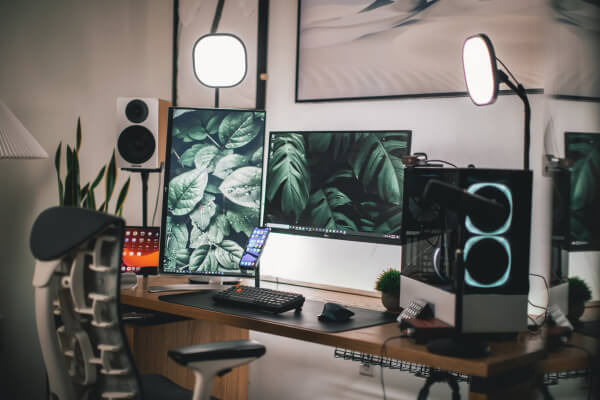
In the competitive realm of modern gaming, performance isn’t just about the CPU and GPU – it’s also about the display that translates your system’s power into immersive visuals. A high refresh monitor can dramatically reduce motion blur and input lag, turning fast-paced titles into crisp, responsive experiences. This guide dives deep into every aspect of building a high refresh monitor gaming setup, from selecting the right panel to optimizing ergonomics and connectivity.
Choosing the Right Refresh Rate
The refresh rate, measured in hertz (Hz), determines how many frames an monitor can display per second. A 144Hz or 240Hz monitor offers smoother motion and can match the frame output of high-end GPUs. However, it’s not just number on a sticker – you must align your GPU’s capability, your budget, and game genre. For example, esports titles like Valorant and CS:GO thrive at 144 Hz, while narrative games may not benefit from ultra‑high refresh rates.
When evaluating refresh rates, consider the following:
- GPU output capability: a 144‑Hz monitor is useless if your GPU can’t consistently hit 144 FPS.
- Quality of motion handling: look for adaptive sync technologies such as FreeSync or G-Sync.
- Colour accuracy and response time: 1‑ms GTG on a 144‑Hz panel ensures minimal ghosting.
Optimizing Resolution and Scaling
Higher resolution delivers more detail, but it also increases GPU workload. A common compromise for esports players is a 1920×1080 (Full HD) monitor at 144‑Hz, while gamers who favor storytelling may prefer 2560×1440 (QHD) at 144‑Hz. High refresh rates combined with HDR (High Dynamic Range) can create an engaging visual experience, yet HDR support requires careful calibration.
When setting up resolution, don’t overlook scaling settings. Some 144‑Hz monitors default to 100% scaling, which keeps text sharp but may leave UI elements too small. Adjust scaling in the OS or GPU control panel to strike a balance between visibility and performance. Also, utilize NVIDIA G-Sync Compatible mode on AMD displays for better latency.
Ergonomics and Monitor Placement
Even the best hardware can become a source of discomfort if the setup is poorly arranged. Start by positioning the monitor 20–30 inches from your eyes, slightly below eye level to reduce neck strain. If you use a dual‑monitor arrangement, adjust the tilt so that the center of each screen aligns horizontally with your line of sight.
Ergonomic consideration extends to desk height and chair cushioning. An adjustable stand or monitor arm allows fine‑tuning of height, angle, and distance. Also, incorporate eye‑health features: anti‑glare coatings, blue‑light filters, and adjustable brightness can mitigate eye fatigue during long marathon sessions.
Connectivity and Cable Management
Cables are more than just conduits; they can affect signal clarity and aesthetics. Opt for DisplayPort 1.4 or HDMI 2.1, depending on your GPU. DisplayPort is preferred for high refresh rates below 144 Hz, while HDMI 2.1 can carry 4K at 144 Hz or 8K at 60 Hz.
Use high‑quality cables and ensure they are seated snugly. To avoid cable clutter, employ cable ties or under‑desk channels. Many modern displays feature a single‑port “USB‑C” that can handle video and power simultaneously, further simplifying the desk layout.
Final Setup Checklist
- Choose a 144‑Hz or 240‑Hz monitor with 1‑ms LED response time.
- Confirm GPU can consistently hit your monitor’s refresh rate.
- Enable adaptive sync (FreeSync or G‑Sync) to mitigate tearing.
- Set optimal resolution and scaling based on your preference.
- Position monitor 20–30 inches away, slight tilt, and eyes level.
- Use DisplayPort for 144‑Hz or HDMI 2.1 for 240‑Hz setups.
- Organize cables with ties or under‑desk organizers.
- Adjust brightness, contrast, and color profile with your GPU’s calibration tools.
- Look after ergonomics: chair height, lumbar support, screen distance.
Ready to elevate your gameplay? Select the monitor that fits your budget and play style, and transform your gaming rig into a high‑refresh, low‑latency powerhouse. Whether you’re a competitive esports player or a casual enthusiast, the right display changes the way you see the game—and the world.
Frequently Asked Questions
Q1. What is a high refresh monitor and why is it important for gaming?
A high refresh monitor can display many frames per second—commonly 144 Hz or 240 Hz—reducing motion blur, stutter, and input lag. This makes fast‑paced games feel smoother and more responsive. While the benefit is most noticeable in competitive titles, it also enhances overall visual fluidity for all players.
Q2. How do I match my GPU performance with the monitor’s refresh rate?
First, check your GPU’s maximum FPS at the resolution you intend to play at. If it rarely exceeds 144 FPS, a 144‑Hz panel is sufficient. For higher rates, like 240 Hz, ensure the GPU can consistently hit those numbers; otherwise you’ll see diminishing returns.
Q3. Do I need adaptive sync technologies such as FreeSync or G‑Sync?
Yes. Adaptive sync eliminates tearing and minimizes judder by synchronizing the display’s refresh rate to the GPU’s output. FreeSync is AMD’s open standard, while G‑Sync is NVIDIA’s proprietary solution—many panels now support both, offering greater flexibility.
Q4. What resolution and scaling should I use for optimal gameplay?
Full HD (1920×1080) at 144 Hz works great for esports; QHD (2560×1440) at the same refresh offers richer detail without a huge GPU load. Adjust OS scaling to keep UI readable—usually 100‑110 % works best on modern Windows PCs.
Q5. How do I set up ergonomics and cable management for a high refresh gaming desk?
Position the monitor 20–30” from your eyes, slightly below eye level, with a thin ergonomic arm for fine tuning. Use cable ties or a desk trough, keep cables short and neatly routed, and choose an anti‑glare screen with blue‑light filtering to reduce eye strain during long sessions.