As newer GPUs arrive, the world of gaming PCs is evolving at a breathtaking pace. With each CPU, memory, and display upgrade, players demand higher frame rates, more realistic graphics, and smoother gameplay. By staying on top of the newest gaming PC hardware trends, you can future‑proof your build and keep the edge over slower systems. Gamers now expect instant load times, high frame rates, and content that looks as close to reality as possible. New titles routinely push hardware limits, demanding more from every component.
This article explores the breakthroughs that are shaping gaming PCs today, from the dazzling RTX 40 series and AI‑based upscaling to PCIe 5.0’s expansive bandwidth and next‑generation VRAM investments. We’ll also look at how liquid cooling solutions are giving overclockers new freedom and what that means for performance and longevity. Whether you’re a casual player or a serious esports competitor, the information here will help you make smarter hardware choices. Hardware manufacturers respond with incremental improvements, layering new features and capabilities. Understanding these forces ensures your system keeps pace with evolving software.
Simultaneously, game developers are pushing graphical fidelity with dynamic lighting, volumetric effects, and complex physics. As engines adopt more realistic rendering pipelines, the demand for higher GPU throughput rises. Developers are also integrating AI‑driven assets, so hardware matching AI upscaling capabilities becomes essential. This dynamic synergy between software and new hardware keeps the market moving at a rapid tempo.
RTX 40 Series and AI Upscaling
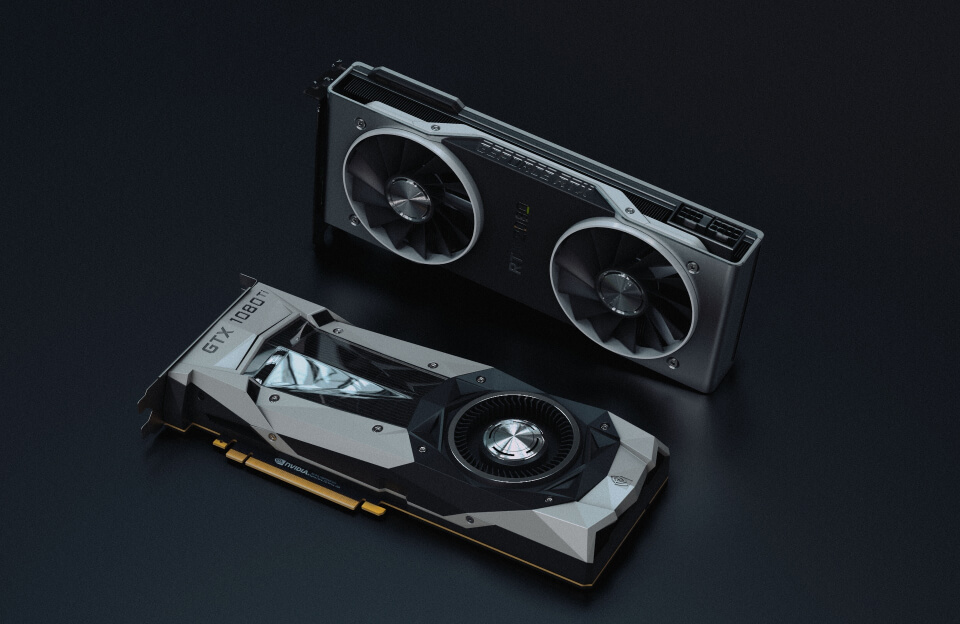
The NVIDIA RTX 40 series, built on Ada Lovelace, delivers up to 2‑3× the performance of its predecessor while supporting real‑time ray tracing at 4K. Each card includes vast numbers of Tensor cores that power DLSS 3, NVIDIA’s AI upscaling technology that delivers extra frames while keeping workloads light. NVIDIA’s official page details performance gains across titles like Doom Eternal and Cyberpunk 2077. The architecture also introduces new RT cores, enhancing ray‑traced reflections and shadows with minimal performance penalty. Developers can now prepare future titles that leverage ray tracing as a core feature rather than an add‑on. The result is a more immersive visual experience on capable displays.
For gamers concerned about power consumption, the RTX 4060 Ti still manages to hit 160 W, a modest increase over the previous generation’s 225 W powerhouse. Meanwhile, the RTX 4090 pushes the envelope to 450 W but feels like a diesel engine for the most demanding scenarios. The performance‑per‑watt ratio improvement is a key factor for gamers building thermally limited or fan‑controlled systems. In addition, NVIDIA offers an updated driver bundle that further optimizes power states for each GPU tier. These adjustments can shave off 5–10 % of idle electricity usage, noticeable over long periods.
DLSS 3 introduces frame‑generation, allowing the GPU to predict future frames. Benchmarks show that heroes like the Call of Duty franchise can reach 200 fps on high settings, while titles such as Red Dead Redemption 2 hit 120 fps without sacrificing visual fidelity. The technology relies on deep learning models that are fine‑tuned for each game, ensuring adaptive quality that doesn’t feel artificial. DLSS frames are stitched together with temporal filters to maintain consistency. Early adopters report smoother motion in fast‑paced shooters, reducing motion blur compared to conventional upscaling. This level of framerate lift is especially valuable on 144 Hz monitors.
Because DLSS works only on NVIDIA hardware, users interested in AMD GPUs must look at Fidelity FX, which serves a similar role but relies on more traditional super‑sampling techniques. However, AMD’s RDNA 3 lineup brings its own set of optimizations, particularly for Ray Acceleration Engines (RAE), which give a competitive price/performance margin. AMD also offers their own adaptive shading feature that dynamically reduces work on less demanding pixels. Some developers implement hybrid solutions that support both DLSS and Fidelity FX, allowing cross‑platform compatibility. This gives gamers a choice between AI upscaling and more conventional solutions.
The Rise of PCIe 5.0 and Ultra‑Wide Bandwidth
One of the biggest infrastructure upgrades in recent years is PCIe 5.0, which offers double the throughput of PCIe 4.0—up to 32 GB/s per lane. For gamers, this translates to faster storage, larger VRAM transfers, and low‑latency communication between components. This bandwidth leap is crucial for next‑generation SSDs and high‑speed GPUs that push data into the memory subsystem at lightning speed. With NVMe 4.0, the 2020s highlighted the need for faster media, driving the development of PCIe 5.0 as a future standard. The recent introduction of the PCIe 5.0 spec allows motherboards to support LGA 1700 x1400 sockets in new chipsets. This ensures that older CPUs can remain viable while still benefiting from increased I/O performance.
In 2024, many motherboards now support PCIe 5.0 slots, while flagship GPUs such as the RTX 4090 are already optimized to shape the new interface. However, most gaming drives are still NVMe 1.4, meaning an entire generation of graphics cards will go under‑utilized until broader adoption. The PCIe 5.0 overview explains how the spec adds a 133 MHz clock to achieve double the bandwidth. Users should also be aware that BIOS updates may be necessary to enable full PCIe 5.0 functionality. Many OEMs release firmware packages that unlock the full potential of the interface on their motherboards.
For 4K gamers, PCIe 5.0 is almost a necessity. The data rates reduce bottleneck latency in multi‑GPU setups, especially when paired with AMD’s CrossFire and NVIDIA’s SLI (which is largely discontinued). Even for single‑GPU builds, the extra throughput can spare data bandwidth for high‑resolution texture streaming, improving frame consistency. Richer textures mean less loss of detail when zooming into dense environments. This also allows for real‑time ray‑traced reflections without tearing or stuttering.
Memory latency will also improve as CPUs incorporate DDR5 and CL16‑like timings. In practice, this means tri‑cabled cache‑coherent memory access for gaming workloads, enabling faster load times for large open‑world titles such as Microsoft Flight Sim. DDR5 also improves power efficiency, reducing heat generation and allowing overclocking in compact cases. Some motherboard manufacturers advertise an “X4” or “X8” lane mode that expands the number of active lanes for high‑performance GPUs. The result is an overall smoother experience during heavy memory usage.
Next‑Generation VRAM and Memory Pricing
Modern GPUs rely heavily on dedicated memory; the RTX 4090 boasts whopping 24 GB of GDDR6X, while upcoming models promise 36 GB or more. This incremental increase in VRAM is a direct response to games demanding higher texture pools and larger scene data. More VRAM also ensures that future titles pushed in 4K or 8K will not suffer texture stutters. As prices for GDDR6X components stabilize, manufacturers are exploring hybrid memory solutions that combine faster GDDR6 and standard DDR5 in a single board. Such hybrids aim to balance performance and cost while providing flexibility to game developers.
According to data from Tom’s Hardware research, the cost per GB of GDDR6X has dropped by nearly 30% over the last two years. Despite the price reduction, VRAM remains the most expensive portion of a graphics card, often accounting for 40% of total unit cost in high‑end machines. Gamers should balance the need for high VRAM against the performance benefits your primary titles demand. In many cases, 16 GB is sufficient for 1440p resolution, freeing up budget for a faster CPU. Specialized researchers are also leveraging AI to compress textures more efficiently, reducing VRAM requirements.
The trend also extends to DDR5 DIMMs for CPUs. A 32‑GB DDR5 kit operating at 6000 MHz can cost under $200, yet the performance lift for memory‑heavy games like Warframe or Grand Theft Auto V is quite visible. DDR5’s higher clock speeds and lower power envelope make it an attractive upgrade even for mid‑range setups. Some gamers opt for low‑latency DDR5 modules to maximize frame pacing during CPU‑bounded titles. Future BIOS developments will include tighter timings without sacrificing stability.
There’s also an emerging product line: HBM3e, which offers higher bandwidth per GB but is far more expensive than GDDR6X. Currently, HBM is primarily found in workstation GPUs, but an AMD “Radeon™ Pro V Series” could mainstream this technology for gaming by 2026. It will be interesting to watch how this competes against GDDR6X’s cost‑effectiveness. Early prototypes show bandwidth of 1.2 TB/s, compared to GDDR6X’s 1.1 TB/s. However, power consumption per GB remains a concern. The ultimate winner will likely depend on developer support and price stabilization.
Liquid Cooling and Thermals for Overclocking
As GPUs become more powerful, thermals become a limiting factor. Conventional air cooling can struggle to keep 4090 temperatures below 80°C under sustained loads. Liquid cooling—not just single‑flow pump‑and‑block kits but also all‑in‑one (AIO) units—provide consistent temperature drops of 10‑15°C over standard coolers. This technology also reduces fan noise, allowing for a quieter gaming environment. Some custom loop designs incorporate cold plates that contact both CPU and GPU, distributing heat evenly across the platform. Wear on pump components can be mitigated with high‑quality bearings.
A recent study from Gartner reveals that 65% of high‑end PC builders now prefer AIOs for GPU cooling. Their findings also show a 5‑point jump in overclocking potential when using liquid solutions versus air. That means more frames for titles such as CS:GO and Valorant. The study also notes the importance of proper radiator placement to avoid hot air recirculation. Many AIOs come with quality control seals that guarantee leak‑free operation for at least five years.
Installation can be more complex, requiring careful cable management and BIOS adjustments for pump‑timings. However, many modern AIO kits come with pre‑selected settings that work across popular chipsets. For hobbyists, custom loops offer flexibility to mix XMP profiles and water block designs. Maintenance involves periodic coolant changes, typically every 12–18 months, to keep thermal performance stable. Regular checks of pump bearings ensure no noise or vibration arises during long sessions.
Inside the liquid loop, the radiator size matters. A 240‑mm radiator can comfortably house a 4090, but 280‑mm or 360‑mm units are recommended if you plan a secondary GPU or future upgrades. Research papers on radiator thermodynamics illustrate how surface area directly reduces coolant temperature. Some liquid coolers also feature integrated RGB, giving a visual aesthetic to the system. Manufacturers often include multiple fan sizes to balance airflow and noise. Thermal paste upgrades also help spread heat more efficiently across the GPU die.
Finally, retailers are offering bundled kits that combine GPU AIOs with custom loop components at discounted prices, which can be a smart way to elevate performance if you’re comfortable with DIY. For those who prefer turnkey solutions, many premium GPU brands now ship with pre‑installed liquid coolers on flagship models. These pre‑installed units often feature proprietary pump designs targeting quiet operation. The market trend indicates that more GPU manufacturers will adopt liquid options in the next refresh cycle. Buyers should also consider long‑term warranty coverage when choosing a cooling solution.
Conclusion
With the RTX 40 series and AI upscaling, PCIe 5.0 bandwidth, bursting VRAM, and advanced liquid cooling, the gaming PC landscape is shifting toward higher performance and smarter efficiency. By aligning your build strategy with these hardware trends, you’ll stay competitive while maximizing your investment. Next step: plan, compare specs, and start building or upgrading—your future gaming experience awaits!