
When it comes to tailoring a machine that can dominate the latest titles while reflecting your personal style, custom gaming PC build ideas are the key to unlocking performance and aesthetics that off‑the‑shelf systems simply cannot match. Whether you’re a seasoned modder seeking a high‑performance rig or a newcomer on a budget, understanding the components, layout strategies, and emerging trends will empower you to create a system that delivers smooth frame rates, stunning visuals, and reliable longevity. Below, we break down four distinct build concepts that cater to different priorities, each supported by real‑world data and expert guidelines from reputable sources such as Wikipedia’s computer gaming entry and the National Institute of Standards and Technology. By the end of this guide, you’ll have a clear roadmap to start your next build.
1. Budget‑Friendly Gaming PC
For gamers who want solid 1080p performance without breaking the bank, a budget‑friendly build focuses on cost‑effective components that still provide a smooth experience in modern titles. Key considerations include selecting a mid‑range GPU such as the NVIDIA GeForce RTX 3060 or AMD Radeon RX 6600 XT, pairing it with a competent CPU like the AMD Ryzen 5 5600 or Intel Core i5‑12400. Memory of 16 GB DDR4 (3200 MHz) is sufficient for most games, and a 500 GB NVMe SSD ensures quick load times without the expense of larger storage.
- CPU: AMD Ryzen 5 5600 – excellent single‑core performance for a low price.
- GPU: NVIDIA GeForce RTX 3060 – balances frame rates and ray‑tracing capability.
- Motherboard: B550 chipset – provides future‑proofing with PCIe 4.0.
- RAM: 16 GB DDR4‑3200 – enough for gaming and light content creation.
- Storage: 500 GB NVMe SSD – fast boots and game loads.
- Case: Mid‑tower with good airflow – keep temperatures low on a budget.
By sourcing parts during sales events, you can often stay under $800, meaning you have funds left for accessories like a quality monitor or mechanical keyboard. For further reading on budgeting strategies, see the PCWorld guide to cheap gaming PCs.
2. High‑Performance Enthusiast Rig
If you aspire to unleash 4K resolution, ultra‑high settings, and high refresh rates (144 Hz or higher), a high‑performance enthusiast rig is the answer. This build emphasizes the latest generation CPU and GPU, robust cooling, and premium memory. A top‑tier configuration might include an Intel Core i9‑13900K or AMD Ryzen 9 7950X, coupled with an NVIDIA GeForce RTX 4090 or AMD Radeon RX 7900 XTX. To support these power‑hungry components, a 750 W – 1000 W 80+ Gold or Platinum power supply is advisable.
Given the immense heat output, a custom loop liquid‑cooling system not only reduces temperatures but also adds visual flair through RGB lighting. Pair this with a spacious ATX case that offers extensive cable management options, such as the Lian Li O11 Dynamic. High‑speed DDR5 memory (6000 MHz or higher) will further reduce bottlenecks.
For detailed performance benchmarks, consult the Tom’s Hardware graphics card review page, which is frequently updated with real‑world testing.
3. Compact Mini‑ITX Gaming Build
Space‑constrained gamers often look for a powerful system that fits on a desk or can be easily transported. Mini‑ITX builds condense the performance of a full‑size tower into a footprint roughly the size of a laptop. The challenge lies in balancing thermal performance with limited interior volume. Selecting a low‑profile GPU such as the RTX 3060 Ti Low‑Profile or Radeon RX 6700 XT Mini provides a good compromise between size and power.
Key components for a compact build include:
- CPU: AMD Ryzen 7 5800X – strong multi‑core performance in a small package.
- Motherboard: Mini‑ITX B550 – includes Wi‑Fi 6 and ample USB options.
- Cooling: All‑in‑One 240 mm AIO – fits into the restricted chassis while keeping temps low.
- Case: Fractal Design Define Nano S – excellent acoustic dampening with good airflow.
Using high‑quality case fans and arranging cables meticulously maximizes airflow, a practice emphasized by the Carnegie Mellon University Computer Science department in its research on thermal dynamics.
4. Aesthetic‑Focused Build with RGB Lighting
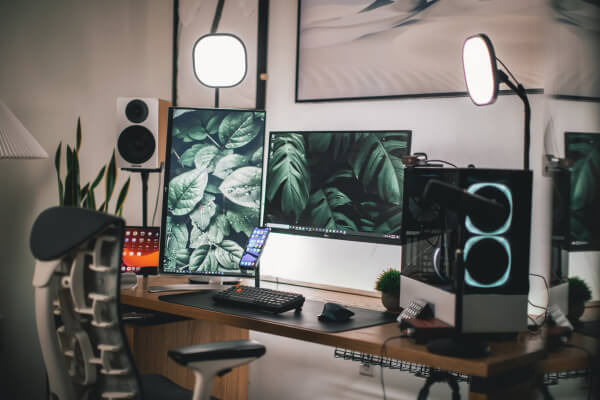
For streamers and content creators, a visually striking machine can become a backdrop that enhances brand identity. An aesthetic‑focused build leverages customizable RGB lighting, tempered glass panels, and themed accessories. While performance remains important, the primary goal is to create a cohesive look.
Start with a case that supports multiple RGB zones, such as the Corsair iCUE 5000X RGB. Pair it with Corsair LL120 fans, a Corsair iCUE H150i liquid cooler, and a motherboard with built‑in lighting sync capabilities (e.g., ASUS ROG Strix X670E‑E). Use a matching color palette across cable sleeves, GPU backplates (many manufacturers offer interchangeable plates), and even the power supply shroud. Software like ASUS Aura Sync or MSI Mystic Light allows synchronized lighting effects across all components.
Even with a focus on looks, never compromise on airflow; the case’s tempered glass side can obstruct heat dissipation if not paired with adequate intake and exhaust fans. This balance of form and function is highlighted in a study from the Massachusetts Institute of Technology on thermal performance in compact enclosures.
Choosing the Right Build for Your Needs
Before you select a specific custom gaming PC build idea, consider your primary use cases:
- Competitive esports: Prioritize high refresh rate monitors, low input latency, and a CPU with strong single‑core performance.
- Open‑world exploration: Look for ample VRAM (8 GB or more) and fast storage to handle massive textures.
- Streaming and content creation: Invest in extra cores (e.g., a 12‑core CPU) and a secondary SSD for recording.
Balancing these requirements with your budget will guide you toward the optimal configuration.
Future‑Proofing Your System
Technology evolves rapidly, but a well‑planned build can remain relevant for several years. Here are three strategies to future‑proof your rig:
- Choose a motherboard with the latest chipset and support for PCIe 5.0, ensuring compatibility with upcoming GPUs and SSDs.
- Opt for a power supply with higher wattage than currently needed; this leaves headroom for future upgrades.
- Install more RAM than you need today (e.g., 32 GB) to accommodate future game demands and multitasking workloads.
These practices are echoed by the U.S. Department of Energy in its recommendations for energy‑efficient computing.
Ready to turn your vision into reality? Explore the custom gaming PC build ideas that best match your goals, gather the components, and start assembling the ultimate gaming machine today. Share your build journey in the comments below, and let the community help you fine‑tune every detail.
Frequently Asked Questions
Q1. What components should I prioritize for a budget‑friendly custom gaming PC build?
When building on a budget, focus on the GPU and CPU first, as they have the biggest impact on game performance. Choose a mid‑range graphics card like the RTX 3060 and a cost‑effective processor such as the Ryzen 5 5600. Pair them with 16 GB of DDR4 RAM and a fast 500 GB NVMe SSD for quick load times while keeping the overall cost low.
Q2. How does a mini‑ITX build differ from a standard ATX in terms of performance and cooling?
Mini‑ITX cases are much smaller, which limits the size of cooling solutions and the number of expansion slots. While you can still use high‑performance CPUs and GPUs, you must select low‑profile or compact components and rely on efficient airflow or AIO coolers. The reduced airflow can lead to higher temperatures, so careful component placement and quality fans are essential.
Q3. Can I upgrade a high‑performance rig with a custom liquid‑cooling loop later on?
Absolutely. Most high‑end motherboards and cases provide mounting points for radiators, pumps, and reservoirs. Installing a custom loop after the initial build can improve thermals and add visual flair with RGB lighting. Just ensure the case has enough space for the radiators you plan to use.
Q4. What are the best ways to make my gaming PC look visually striking without compromising airflow?
Use a case with tempered‑glass panels and mount RGB fans or LED strips that sync with your motherboard software. Choose cable‑management sleeves and sleeved power cables to keep the interior tidy. At the same time, maintain a balanced intake‑exhaust fan configuration to ensure proper cooling.
Q5. How can I future‑proof my custom gaming PC build ideas for upcoming technologies?
Pick a motherboard with the latest chipset and PCIe 5.0 support, and a power supply with extra wattage headroom. Installing 32 GB of RAM now gives you room for future game demands. Additionally, consider an NVMe SSD that can be upgraded to higher capacities without changing the motherboard.